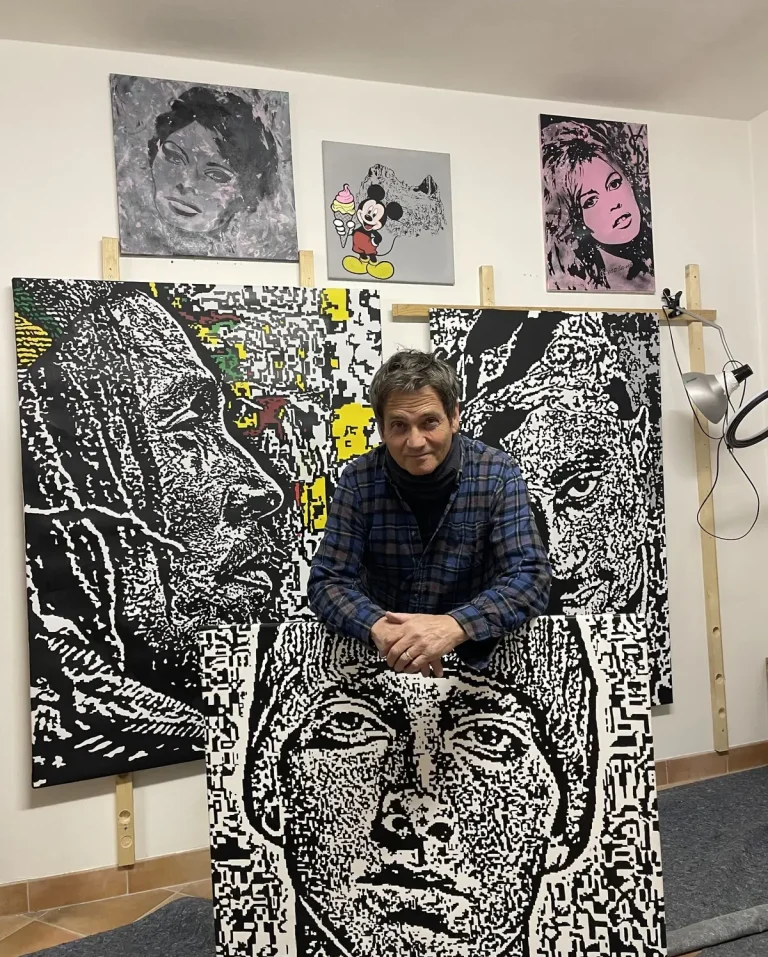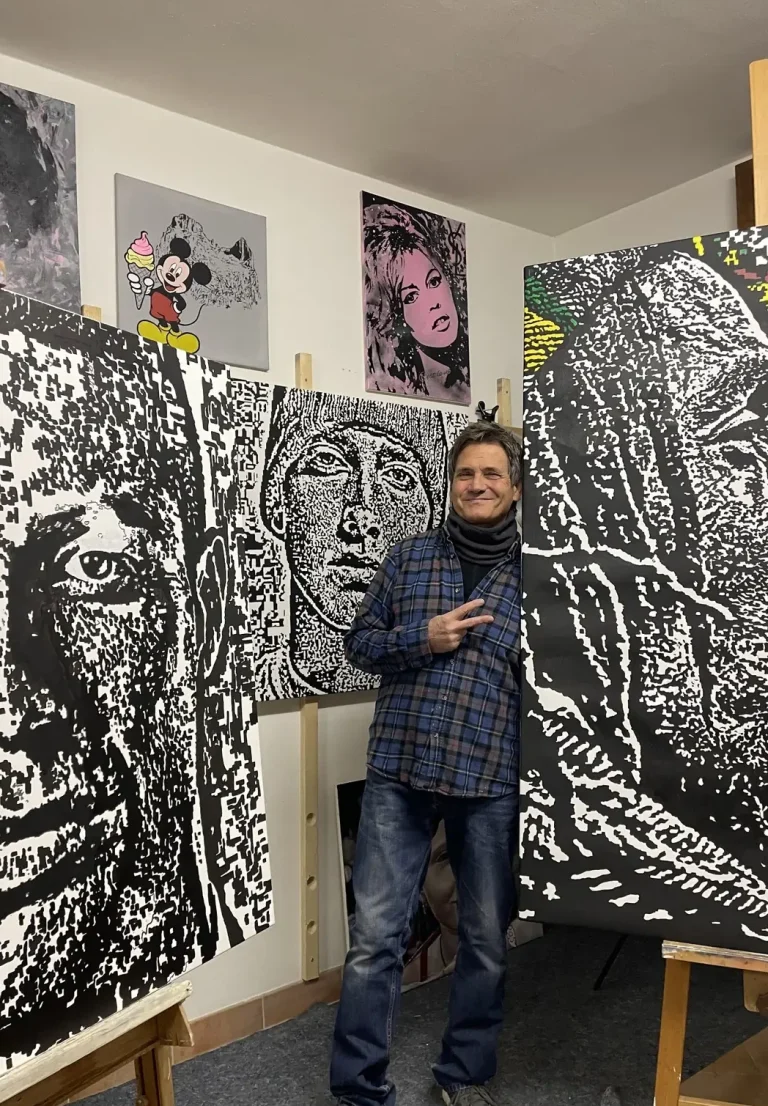
The Artist
Renzo Valenti
Born in Germany in 1963, Renzo Valenti is a self-taught contemporary artist based in Italy. Painting has been part of his life since childhood and has shaped his artistic path through curiosity, observation and continuous experimentation.
He explored a wide range of artistic approaches, from hyperrealism and photorealism to portraiture, abstract painting and Pop Art. Rather than committing to one particular style, he continued to experiment and develop his own way of seeing and working.
His work was presented in group exhibitions and competitions in Munich, Baden-Baden, Koblenz, Vienna and the United States, including an exhibition at the Michael Kisslinger Gallery in New York in 1994.
Throughout his artistic development, Renzo continued to paint, study and experiment independently. Over time, this search for new forms of expression led to a new direction in his work.
The Path to Binary Faces
The idea behind Binary Faces grew out of this ongoing experimentation.
With digital imagery becoming an increasingly natural part of everyday life, Renzo became interested in bringing this visual language into traditional painting. He wanted to explore how the look of a digital image could be combined with the physical and personal nature of a handmade painting.
The idea was not planned as a finished style from the beginning. It developed gradually through experimentation and became more defined over time.
The first experiments began with a portrait of Eminem. Renzo wanted to explore not only the connection between digital imagery and traditional painting, but also how a recognizable human face could emerge from thousands of individual painted fragments.
What started as an exploration of this connection eventually developed into a distinctive new visual language.
Binary Faces combines the visual precision of the digital world with the individuality and craftsmanship of traditional painting.
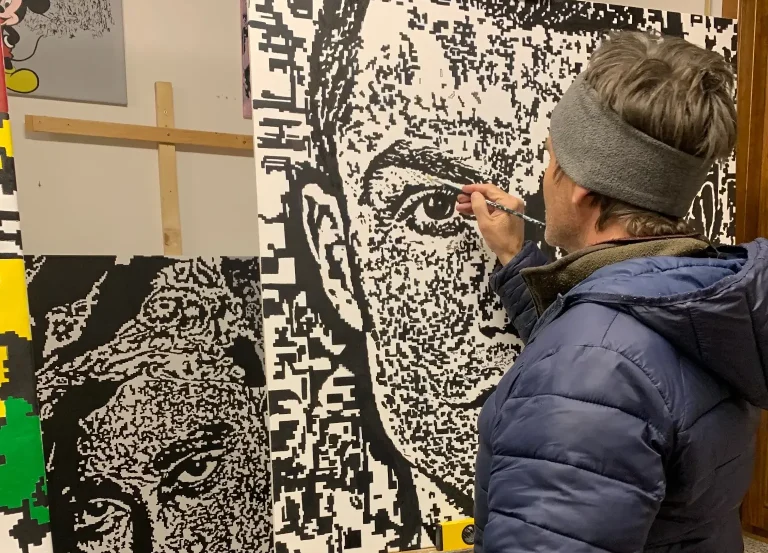
His works are entirely hand-painted on canvas, using oil and acrylic.
A New Visual Language
From a distance, the works can appear almost digital. Up close, thousands of individually painted fragments become visible.
This connection between the digital appearance and the physical process of painting is at the heart of Binary Faces.
It reflects an idea that has become increasingly relevant to contemporary life: bringing the visual language of today's digital world together with the enduring process of making art by hand.